
Biology · BGCSE / Disease and immunity
StructuredPast exam questionForm 5 · BGCSE
Immunity and HIV.
- aDescribe how the human body develops immunity after an infection. [4]
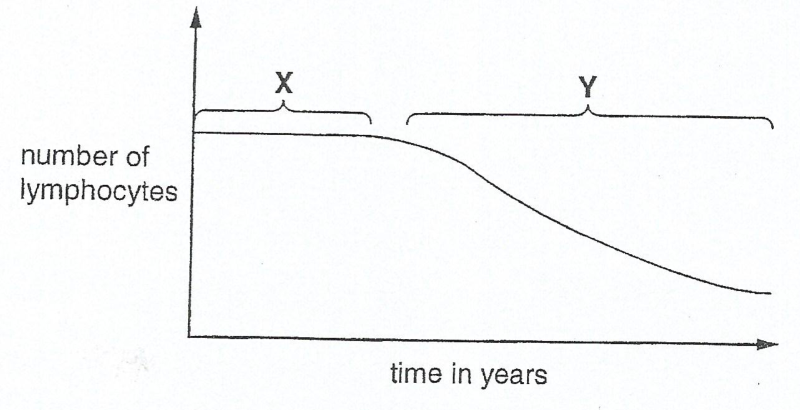
- bFigure 1.2 shows changes in the number of lymphocytes in a person infected with HIV: the number stays high and steady during period X, then falls steadily during period Y. Suggest an explanation for the number of lymphocytes during periods X and Y. [4]
You'll mark your own answer against the marking guide when you hand it in.
Source: BEC BGCSE Biology 2007, Paper 3, Question 1(d)
Report a problem
More like this
- Which cells produce antibodies?
- Antibiotics are used to treat infections caused by…
- HIV attacks…
- Discuss the role of mosquitoes and a named protozoan in causing and transmitting malaria.
- Discuss the role of micro-organisms in production of the following.
- Answer the following about drugs.
- Gonorrhoea and HIV/AIDS are human sexually transmitted diseases.
- Malaria is an insect borne disease caused by a protozoon.