
Biology · BGCSE / Transport in plants and animals
StructuredPast exam questionForm 5 · BGCSE
Fig. 2.1 represents a sequence of events 1, 2 and 3 which occur during a heartbeat. 1: muscles in atria walls contract and blood is forced into X. 2: muscles in ventricle walls contract and force blood through the aorta and blood vessel Y; bicuspid and tricuspid valves close. 3: all heart muscles relax; blood flows into the atria and some blood trickles into the ventricles.
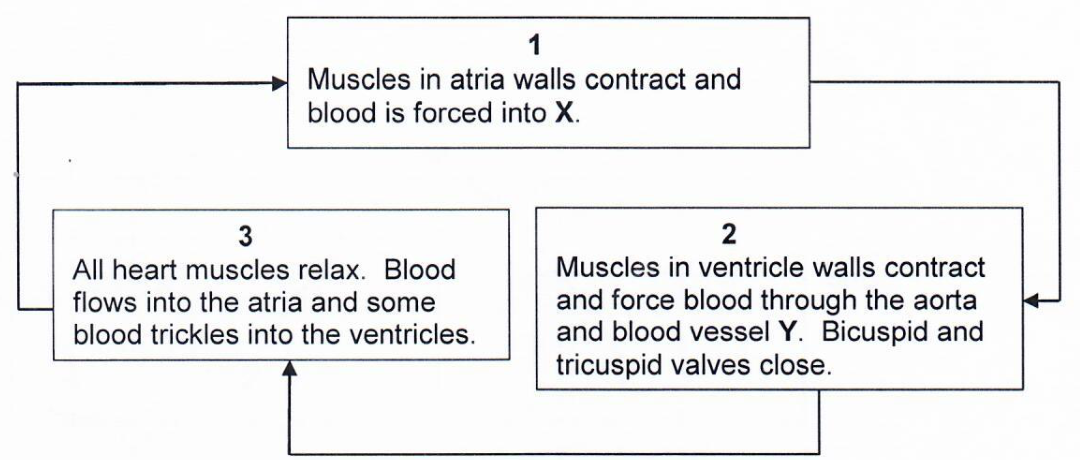
- aIdentify structure X. [1]
- bIdentify structure Y. [1]
- cState the significance of the action of the valves in event 2. [1]
- dState changes that occur in valves within the aorta during event 2. [1]
You'll mark your own answer against the marking guide when you hand it in.
Source: BEC BGCSE Biology 2018, Paper 3, Question 2(b)
Report a problem
More like this
- Which chamber of the heart has the thickest wall?
- Translocation is the movement of…
- Describe the path of blood from the body back to the body, through the heart and lungs.
- Fig. 2.1 shows the left side of the heart of a person.
- Table 2.1 shows types of blood vessels (artery, vein, capillary) and descriptions of features. Show which type of blood vessel has each feature. One …
- Fig. 6.1 shows a longitudinal section of one side of the heart.
- Explain the risk of blood transfusion from a healthy person of blood group A to a person of blood group B.
- Fig. 3.1 shows a network of capillaries in a human tissue. Oxygen leaves the capillaries into the cells and gas Y moves from the cells into the blood…